Anonymous workforce evidence for your menopause action plan
One place to build the plan you have to publish
A menopause action plan needs evidence from your own workforce, a risk assessment, a policy and a published document. Summ Base is all of it in one place, and most of it writes itself from your own numbers.

The problem
You already asked. They did not answer honestly.
Telling the organisation that decides your promotion is a career risk. So internal surveys read fine, and people leave anyway.
It is not even loud. They do not say anything. They just quietly leave.
HR director, 20 years in manufacturing and engineering
I went through it myself, and I did not tell people. I just did not.
HR director, 20 years in manufacturing and engineering
A lot of companies think we will just put a policy in place. Maybe a working group, like all the other working groups we have ever had.
HR director, on how menopause plans usually go
It cannot be three people in this part of the business said this, when only three women work in that team. It has to be cut in a way that helps.
HR director, on reporting safely
Boards love data. But you have to keep looking at it, because as you put things in place the data changes.
HR director, on measuring more than once
You end up leaving the job you love. The one that helps define you, that you get joy from.
Woman in a senior professional role
People are not sure what to say to each other. Managers do not want to say the wrong thing.
HR director, on why nobody raises it
67%
of employed women aged 40 to 60 with menopause symptoms say those symptoms have a mostly negative effect on them at work
1 in 10
women who worked during menopause left a job because of their symptoms
Over £30,500
to replace one woman earning £25,000 who leaves because of her symptoms
Oxford Economics, cited in the Women and Equalities Committee report, 2022
What you get
The whole job, in one place
Done properly, a menopause action plan is a survey tool, a consultant, a template, a legal read and a spreadsheet that never quite agree with each other. This replaces the lot.
Find out what is actually happening
Without An internal survey people answer carefully, or a consultant running focus groups.
Here An anonymous pulse they answer honestly, live results from 10 answers, ranked by demand.
Check whether what you already fund works
Without Usage reports from the suppliers being assessed.
Here Your own people say whether they knew about it, used it, and would recommend it.
Write the evidence section
Without Reading a spreadsheet and writing a paragraph you hope stands up.
Here Written from your own numbers, ready to paste, every figure checkable on screen.
Choose the actions
Without Reading the government list and guessing which ones fit you.
Here The 18 recommended actions with your own demand attached, and one button that drafts a plan.
The risk assessment
Without A template someone adapts, one work area at a time.
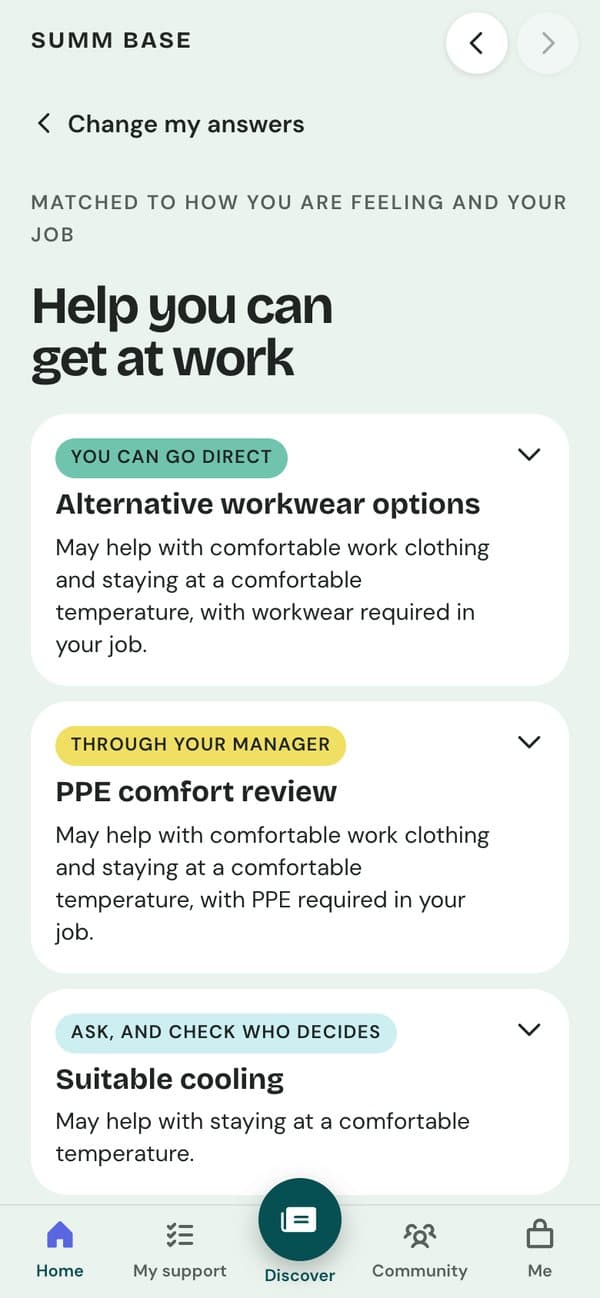
Here Composed area by area, pre-filled from the pulse where the pulse has something to say.
Policy, managers, comms
Without Three more documents to source and adapt.
Here A policy draft, a manager one-pager, a poster and an invitation, all personalised to you.
Publish, then prove it moved
Without A calendar reminder, and starting over next year.
Here A submission pack, deadline reminders, and a second round that writes its own before and after.
Privacy
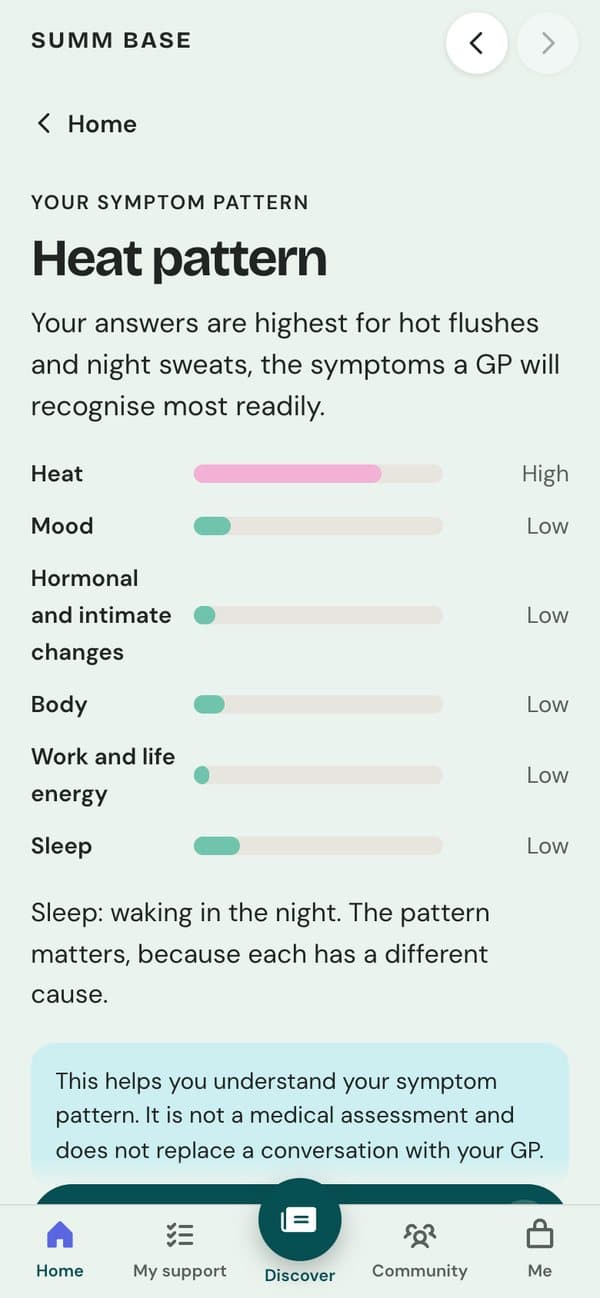
You see the pattern. Never the person.
You never see who answered. You see what your workforce said, only ever in numbers.
| What you see | What stays private |
|---|---|
| How many people responded | Individual names |
| Which challenges are most common | Individual responses |
| What people asked for, by work area | Who asked for what |
| Whether things are improving between surveys | Any individual record |
| Action plan evidence | Anything that identifies a person |
Groups of fewer than 10 people are never shown. This is architecture, not policy.
Voluntary now. Expected to become mandatory from spring 2027.
Menopause action plans are voluntary from 6 April 2026 and, subject to legislation, are expected to become mandatory from spring 2027 for employers with 250 or more employees. The guidance runs as six steps, and the first is to understand the issues in your own organisation using workforce data. That first step is what Summ Base does.
What the law actually requiresStart with where you stand
Create a free account and build your whole plan for nothing. Buy only when you want the survey to go out. Or check your readiness first, in 90 seconds.
Or email hello@summbase.co.uk and we will come back to you within one working day.
Common questions
Menopause action plans, answered
Is a menopause action plan mandatory?
Not yet. Publishing a menopause action plan is voluntary from 6 April 2026 and, subject to legislation, is expected to become mandatory from spring 2027 for employers with 250 or more employees.
The first mandatory deadlines are 30 March 2027 for public authorities and 4 April 2027 for everyone else. Plans are published alongside gender pay gap data.
What must a menopause action plan include?
The guidance sets out 18 suggested actions across five categories. An employer must select at least two: one addressing the gender pay gap and one addressing menopause.
The first step in the guidance is understanding the issues in your own organisation, engaging employees and using workforce data, before you choose which actions to take.
What is a menopause risk assessment?
It is a health and safety assessment of how the working environment affects people experiencing menopause symptoms, and of the controls already in place.
It covers temperature and ventilation, uniform and protective clothing, toilets and rest areas, shift patterns and workload timing. It never assesses anyone individually and never scores symptom severity, which keeps it a workplace assessment rather than a clinical one.
How do I get evidence for a menopause action plan?
Not from an internal survey: answering the organisation that decides your promotion is a career risk, so internal data underreports.
Evidence has to be collected by someone who is not the employer and has nothing to sell in the answer. That is what Summ Base does. An anonymous workforce pulse, live results, and an action list ranked by how many of your own people asked.
Do you take commission from menopause providers?
No. Never.
We are not a menopause provider and we take no commission from any organisation we measure or signpost. It is the reason we can report honestly when support you already fund is not reaching people.
Does Summ Base write the action plan for us?
It composes it with you. The portal holds the government’s 18 recommended actions with your own workforce demand attached, checks the statutory minimum, and assembles the nine-section document. The evidence section is written from your pulse.
A risk assessment composer and a policy template sit alongside it, drafted from your own setup. Everything is information rather than legal advice, and you publish the plan yourself on the gender pay gap service.
How much does Summ Base cost?
The readiness check is free with no sign-up. Act Ready is £1,950, paid once by card: the anonymous survey, live results, your action plan, risk assessment and policy, the submission pack, and the employee space, with round 1 of results included. Full refund any time before you export your submission pack, no questions asked.
Every round is included, so remeasuring next year costs nothing extra. Nothing renews and nothing expires.
What happens after we buy, or get in touch?
Your portal link appears on screen and in your inbox within minutes, with your invoice. The link is your key: no password, and no onboarding meeting unless you want one.
Setup is self-serve: pick your industry, the portal fills in your sector’s departments and support options, and the invitation is ready-written. The how it works page walks every step, and replies to the welcome email reach a person.
How quickly can we launch a pulse?
Days, not months. Once your portal is open, setup takes about ten minutes, employees answer in under two, and results unlock once 10 people have responded.
Small organisations included: the survey works from a few dozen people upwards, and the 10-person reporting floor protects anonymity at any size.